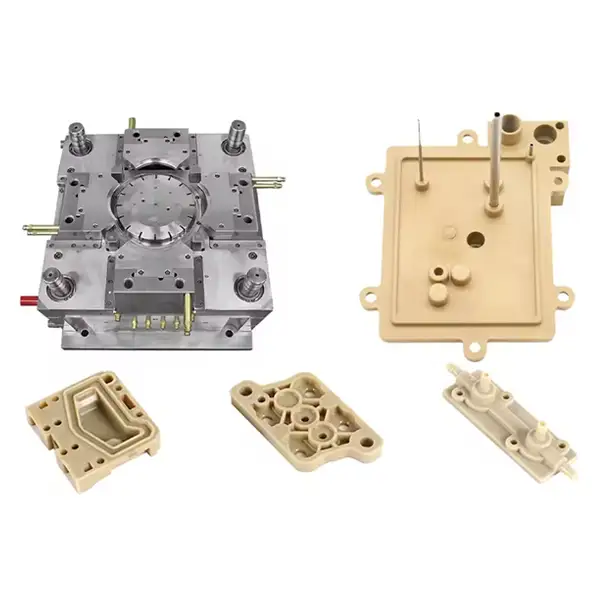
Custom PEEK Injection Molding with AIM plastic, with design and engineering support, OEM, ODM, injection mold making, competitive price, shipment support
PEEK injection molding is a highly specialized plastic injection molding and high-performance thermoplastic molding process used to manufacture high-performance plastic parts for extremely demanding environments.
PEEK (Polyether Ether Ketone) is an advanced engineering plastic and a semi-crystalline PEEK polymer, widely recognized for its exceptional material properties, including mechanical strength, chemical resistance, and long-term stability under high temperature conditions.
Industries such as aerospace, medical, automotive, oil and gas, electronics, and industrial equipment rely on PEEK plastic injection molding when standard plastic materials cannot meet performance requirements. Typical applications of PEEK include aerospace PEEK components, medical-grade PEEK molding, automotive PEEK parts, and industrial PEEK plastic components.
[bg_collapse_level2 view=”link” color=”#e34507″ icon=”arrow” expand_text=”Read More” collapse_text=”Read Less” ]
Although processing PEEK involves high processing temperatures, strict temperature control, and higher tooling costs, PEEK offers unmatched reliability for high-value components.
This comprehensive guide explains what PEEK injection molding is, how the PEEK injection molding process works, material properties, mold design and tooling requirements, applications, cost factors, and future trends in PEEK plastic manufacturing.
PEEK injection molding is a precision injection molding process that shapes molten PEEK resin into complex PEEK injection molded parts by injecting the resin into a heated injection mold under controlled injection pressure and injection speed. After cooling at a carefully controlled mold temperature, the PEEK part solidifies and is ejected with excellent dimensional stability and mechanical integrity.
Unlike ABS or PP, PEEK requires specialized injection molding machines, high-temperature barrel systems, and robust steel molds for injection molding. Injection molded PEEK components demand precise control of the entire injection process, making PEEK injection molding services suitable only for experienced injection molding service providers with expertise in high temperature plastic molding and precision PEEK molding.
PEEK stands apart from other engineering plastic injection molding materials due to its superior properties of PEEK and performance consistency.
PEEK offers continuous operating temperatures up to 260°C and short-term exposure near 300°C. These heat-resistant plastic parts retain mechanical strength under extreme thermal conditions, making PEEK ideal for aerospace, electronics, and industrial environments.
Injection-molded PEEK exhibits high tensile strength, excellent fatigue resistance, and long-term creep stability. PEEK molded parts perform reliably under constant load, vibration, and stress.
PEEK polymer provides outstanding resistance to fuels, oils, acids, solvents, and aggressive chemicals. Chemical-resistant plastic molding with PEEK also delivers low friction and excellent wear resistance, ideal for moving components.
PEEK offers stable dielectric properties even at elevated temperatures, making injection-molded products suitable for high-performance electrical and electronic systems.
PEEK is inherently flame resistant with low smoke and toxic gas emission, meeting strict aerospace and transportation safety standards.
PEEK injection-molded components outperform metals and standard plastics in high-temperature, chemically aggressive, and high-load environments where high-performance thermoplastic molding is required.
PEEK offers an excellent strength-to-weight ratio, corrosion resistance, and reduced maintenance, allowing manufacturers to replace metal parts with custom PEEK injection-molded parts.
Injection moulding allows precision PEEK molding with tight tolerances, complex geometry, and consistent quality across multiple production cycles.
Unfilled PEEK offers balanced mechanical and thermal properties, high purity, and biocompatibility. It is widely used in medical devices, semiconductor components, and medical-grade PEEK molding.
This filled PEEK grade provides increased stiffness, reduced thermal expansion, and improved dimensional stability for structural parts.
Carbon-filled PEEK grades offer superior strength, wear resistance, and thermal conductivity, making them ideal for aerospace and high-load industrial applications.
Lubricated PEEK reduces friction and wear, commonly used for bearings, gears, and sliding PEEK components.
PEEK resin must be thoroughly dried to prevent hydrolysis, preserve mechanical properties, and avoid surface defects during the molding process.
The melt temperature typically ranges from 360–400°C. Injection molding machines must support high processing temperatures with precise temperature control throughout the barrel and nozzle.
High injection pressure and controlled injection speed ensure complete cavity filling and prevent voids, sink marks, and internal stress.
Mold temperature is usually maintained between 160–200°C. Uniform cooling is essential for dimensional stability and reducing warpage in PEEK injection molded parts.
After cooling, molded parts are ejected and inspected for dimensional accuracy, surface quality, and structural integrity.
Due to extreme heat and pressure, PEEK molding requires hardened steel molds such as H13, S136, or stainless tool steel. Aluminum molds are unsuitable for high temperature plastic molding.
PEEK mold design and manufacturing must include high-temperature resistance, precision venting, robust gating systems, and optimized cooling channels. Insert molding may also be used for integrated metal-plastic components.
Although tooling costs are higher, steel molds provide long service life and consistent quality for PEEK injection molding services.
Maintain uniform wall thickness to prevent sink marks and internal stress. Avoid thick sections that increase cooling time.
A minimum draft angle of 1–2 degrees improves part ejection and protects mold surfaces.
PEEK supports tight tolerances, making it ideal for precision plastic parts. Critical dimensions should be clearly defined.
Use radii to reduce stress concentration, improve durability, and extend mold life in reinforced PEEK molding and standard PEEK injection molded parts.
PEEK injection molded parts are widely used in the medical industry due to their excellent mechanical properties, biocompatibility, and resistance to repeated sterilization. Common applications of PEEK injection molding include surgical instrument components, implantable and non-implantable devices, and sterilizable housings and connectors.
As a high-performance thermoplastic polymer, PEEK can withstand extreme temperature conditions and aggressive cleaning chemicals without degradation, making it ideal for critical medical injection molding applications.
In aerospace applications, PEEK injection molding is valued for lightweight strength and reliability under extreme temperature and pressure. Typical aerospace PEEK components include structural brackets, cable insulation components, and high-temperature connectors.
Glass-filled PEEK injection molding and carbon fiber reinforced PEEK are often used to enhance stiffness and dimensional stability while maintaining low weight. These molded PEEK parts meet strict aerospace standards for performance and safety.
Automotive manufacturers use PEEK injection molded parts for under-hood components, transmission and engine parts, and lightweight metal replacement parts.
Thanks to its high-strength polymer molding capability and resistance to heat, chemicals, and wear, PEEK plastic exhibits stable performance in harsh automotive environments. Injection molding of PEEK enables complex geometry molding and tight tolerance plastic molding for demanding automotive applications.
In oil and gas applications, PEEK can withstand high pressure, extreme temperature, and aggressive chemicals. Common uses include seals, valve components, wear-resistant parts, and high-pressure fittings. PEEK is highly resistant to hydrocarbons and corrosive fluids, making it a preferred injection molding material for long-life molded PEEK parts used in downhole and surface equipment.
PEEK injection molded parts are used for insulators, wafer handling components, and high-purity housings in electronics and semiconductor manufacturing. Due to its electrically insulating plastic molding properties and low outgassing, PEEK supports high-performance injection molding applications where precision, cleanliness, and reliability are critical.
High-quality PEEK injection molding relies on strict dimensional control. Injection molding companies use CMM inspection and first-article inspection to verify that molded PEEK parts meet tight tolerances and design specifications, minimizing shrinkage and dimensional variation.
Material traceability is essential for successful PEEK molding. Resin batch tracking, certification documentation, and controlled handling of PEEK pellets ensure consistent material properties and compliance with industry standards.
The injection molding process requires precise monitoring of processing temperature, injection pressure, injection speed, and cycle time. Advanced injection molding technology and specialized injection molding equipment are used to maintain stability during high temperature injection molding processes.
Finished plastic injection molded parts undergo surface finish evaluation, mechanical testing, and thermal performance validation to confirm excellent mechanical properties and long-term durability.
PEEK resin is significantly more expensive than standard injection molding resins, often costing 10–20 times more than ABS or PP. This reflects the benefits of PEEK, including high temperature resistance, chemical stability, and superior mechanical properties.
PEEK molding requires hardened steel molds designed for high processing temperature and high-pressure injection molding. Precision mold design for PEEK, complex cavities, and robust mold PEEK construction increase tooling investment compared to standard injection molding.
Processing PEEK involves specialized machines, controlled drying of PEEK, longer cycle times, and skilled operators with expertise in the injection molding of PEEK. These factors contribute to higher processing costs.
Despite higher upfront investment, production-grade PEEK parts often deliver lower total lifecycle cost due to durability, reduced maintenance, and long service life in extreme environments.
| Feature | Injection Molding | CNC Machining |
|---|---|---|
| Volume | Medium to high | Low |
| Cost per part | Lower at scale | High |
| Complexity | High | Moderate |
| Repeatability | Excellent | Good |
Injection molding applications are ideal for series production of injection molded PEEK parts, while CNC machining is better suited for prototypes, low-volume PEEK production, or short-run PEEK molding.
PEEK injection molding presents challenges such as high processing temperatures, strict mold and machine requirements, narrow processing windows, and higher initial investment. PEEK has a high melt temperature and poor flow compared to amorphous plastics, requiring expert control to achieve successful PEEK molding. These challenges make experienced injection molders essential.
As industries seek lightweight, corrosion-resistant alternatives, PEEK will continue to replace metal components in high-performance injection molding applications.
Rising demand for biocompatible and sterilizable materials is driving growth in medical PEEK injection molding services.
Automation, AI-driven process control, and advanced thermoplastic processing will improve consistency, reduce scrap, and lower costs.
Efforts to recycle high-performance polymers and reduce waste are gaining attention in PEEK plastic injection molding.
When selecting an injection molding company for PEEK projects, look for experience with high-temperature polymers, advanced molding equipment, in-house tooling capability, and strong quality management systems. Expertise in injection molding material selection, mold design, and processing of PEEK is critical.
A qualified manufacturer ensures stable production, consistent quality, and optimized costs for high-quality PEEK injection molded parts.
PEEK injection molding is a powerful injection molding technology for producing high-performance plastic parts that operate in extreme temperature and chemical environments. With excellent mechanical properties, chemical resistance, and dimensional stability, PEEK enables advanced engineering applications across aerospace, medical, automotive, and industrial sectors.
Although injection molding of PEEK requires higher investment and technical expertise, the advantages of PEEK—durability, precision, and reliability—often outweigh the challenges.
As demand for lightweight, high-performance thermoplastic solutions continues to grow, PEEK injection molding will remain a critical manufacturing method for future high-end injection molding applications.
[/bg_collapse_level2]