

Cooling channel design is one of the most critical yet often underestimated factors in plastic injection molding. While much attention is given to mold design, material selection, and processing parameters, cooling efficiency directly determines cycle time, part quality, dimensional stability, and overall production cost.
In fact, cooling typically accounts for 60–80% of the total injection molding cycle time. Poorly designed cooling channels can lead to long cycles, warpage, sink marks, residual stress, and inconsistent part quality. On the other hand, a well-engineered cooling system can dramatically improve productivity, reduce defects, and extend mold life.
This article provides a comprehensive guide to cooling channel design for efficient plastic injection molding, covering fundamentals, design principles, cooling layouts, conformal cooling, materials, common mistakes, and best practices used in modern mold engineering.
Why Cooling Channel Design Is So Important
The Role of Cooling in Injection Molding
The injection molding process consists of four main stages:
- Filling
- Packing / Holding
- Cooling
- Ejection
Among these stages, cooling is the longest. The molten plastic must solidify sufficiently before the part can be ejected without deformation.

If cooling is:
- Too slow → long cycle times, higher costs
- Uneven → warpage, sink marks, internal stress
- Uncontrolled → inconsistent dimensions and poor surface quality
Thus, cooling channel design is not just about removing heat, but about removing heat uniformly and efficiently.
Impact on Cycle Time and Cost
Even a small reduction in cooling time can have a massive impact on production economics:
- Reducing cycle time by 2 seconds on a 30-second cycle = ~7% productivity gain
- Over millions of parts, this translates into significant cost savings
Efficient cooling channels enable:
- Faster mold opening
- Higher machine utilization
- Lower energy consumption
Influence on Part Quality
Proper cooling channel design directly affects:
- Dimensional accuracy
- Warpage control
- Shrinkage uniformity
- Surface finish
- Mechanical properties
Uneven cooling causes differential shrinkage, which is one of the main reasons for part deformation in plastic injection molding.
Heat Transfer Fundamentals in Injection Molding
To design effective cooling channels, it is essential to understand basic heat transfer principles.
Heat Flow Path
Heat flows in the following sequence:
- From molten plastic
- Through the mold cavity surface
- Into the mold steel
- Into the cooling channel
- Removed by circulating coolant
Each step introduces thermal resistance. Cooling channel design aims to minimize total resistance.
Key Heat Transfer Modes
- Conduction: Heat transfer through mold steel
- Convection: Heat transfer from steel to coolant
- Radiation: Negligible in injection molding
Optimising conduction distance and convection efficiency is the core goal of cooling channel design.
Cooling Efficiency Factors
Cooling efficiency depends on:
- Distance from cavity surface
- Channel diameter
- Coolant flow rate
- Turbulence level
- Mold material thermal conductivity
Basic Principles of Cooling Channel Design
Uniform Cooling Is the Priority
The most important rule:
Uniform cooling is more important than maximum cooling speed
Uneven cooling leads to:
- Warpage
- Sink marks
- Stress concentration
- Dimensional instability
Channel Distance from Cavity Surface
General guidelines:
- Channel centerline distance from cavity surface:
- 1.5–2.0 × channel diameter
- Too close:
- Risk of mold cracking
- Surface temperature variation
- Too far:
- Inefficient cooling
- Longer cycle time
Channel Spacing
- Channel spacing typically:
- 2–3 × channel diameter
- Overlapping thermal fields ensure a uniform temperature distribution
Channel Diameter Selection
Common cooling channel diameters:
- Small molds: Ø6–8 mm
- Medium molds: Ø8–12 mm
- Large molds: Ø12–16 mm
Larger channels allow higher flow but require more mold space.
Cooling Channel Layout Types
Straight Drilled Cooling Channels
Most common and cost-effective solution
Advantages:
- Simple manufacturing
- Low cost
- Easy maintenance
Disadvantages:
- Limited geometry freedom
- Uneven cooling in complex shapes
Best suited for:
- Simple parts
- Thick steel sections
- Low to medium precision requirements
Parallel Cooling Channels
Channels run parallel to each other across the mold.
Pros:
- Uniform cooling for flat parts
- Simple design
Cons:
- Less effective for deep ribs or complex cores
Baffle Cooling
Baffles are thin plates inserted into drilled channels to redirect coolant flow.
Advantages:
- Improves cooling in deep cores
- Low-cost upgrade
Disadvantages:
- Increased pressure drop
- Maintenance required
Commonly used in:
- Core pins
- Deep cavities
Bubblers (Bubbler Cooling)
Coolant flows down a central tube and returns through the outer annular space.
Advantages:
- Effective for long, narrow cores
Disadvantages:
- Limited flow capacity
- Risk of clogging
Spiral Cooling Channels
Spiral channels follow a helical path around cores.
Advantages:
- More uniform cooling than straight channels
Disadvantages:
- Complex machining
- Higher cost
Conformal Cooling Channels
What Is Conformal Cooling?
Conformal cooling channels follow the contour of the part geometry, maintaining a constant distance from the cavity surface.
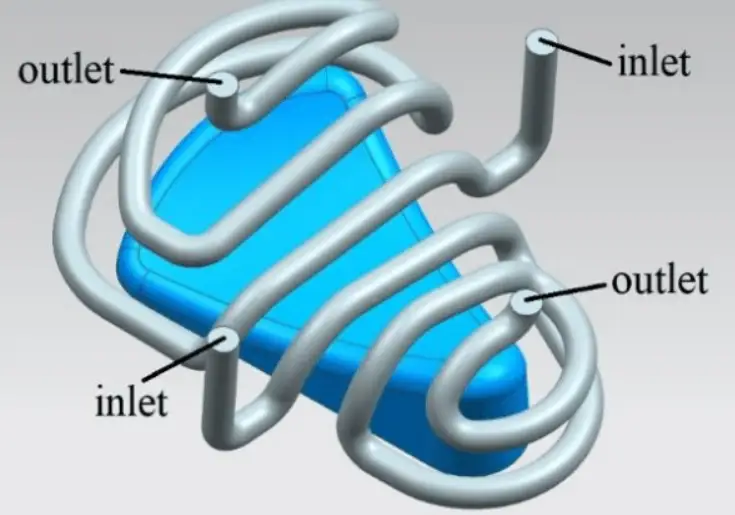
They are typically manufactured using:
- Metal additive manufacturing (3D printing)
- Direct metal laser sintering (DMLS)
- Selective laser melting (SLM)
Advantages of Conformal Cooling
- Up to 30–60% reduction in cooling time
- Highly uniform temperature distribution
- Reduced warpage and sink marks
- Improved part consistency
- Shorter cycle times
Applications Best Suited for Conformal Cooling
- Complex geometries
- Thick-thin wall transitions
- High precision parts
- Medical devices
- Automotive components
- Micro injection molding
Challenges and Limitations
- Higher mold manufacturing cost
- Longer lead time
- Limited repair options
- Requires advanced design expertise
Despite a higher upfront cost, conformal cooling often delivers lower total cost per part in high-volume production.
Cooling Channel Design for Different Mold Components
Cavity Cooling
Key considerations:
- Follow the part contour
- Avoid hot spots near corners and ribs
- Balance the temperature across the cavity surface
Core Cooling
Core areas are harder to cool due to:
- Limited space
- Long heat paths
Common solutions:
- Bubblers
- Baffles
- Conformal cooling
- High conductivity inserts
Slider and Lifter Cooling
Moving components often suffer from poor cooling.
Best practices:
- Independent cooling circuits
- Flexible hoses or rotary joints
- Avoid shared cooling loops with cavity
Mold Materials and Cooling Performance
Tool Steel
Common steels:
- P20
- H13
- S136
Pros:
- Strength
- Durability
- Wear resistance
Cons:
- Moderate thermal conductivity
High Thermal Conductivity Inserts
Materials such as:
- Beryllium copper (BeCu)
- Copper alloys
Advantages:
- 3–5× higher thermal conductivity than steel
- Excellent for hot spots
Limitations:
- Higher material cost
- Lower wear resistance
- Safety precautions required (BeCu)
Aluminum Molds
Aluminum offers:
- High thermal conductivity
- Fast heat dissipation
Best for:
- Prototyping
- Low to medium volume production
Not ideal for:
- Abrasive or glass-filled materials
- Very high volumes
Coolant Selection and Flow Control
Common Coolants
- Water (most common)
- Deionized water
- Water with corrosion inhibitors
- Oil (rare, high-temperature applications)
Water offers the best balance of:
- Thermal capacity
- Cost
- Availability
Turbulent vs Laminar Flow
- Turbulent flow is preferred for efficient heat transfer
- Reynolds number > 4000 is typically targeted
Achieved by:
- Proper channel diameter
- Adequate flow rate
- Avoiding sharp bends and dead zones
Temperature Control Units (TCUs)
TCUs help maintain:
- Stable mold temperature
- Consistent part quality
Proper zoning of cooling circuits allows:
- Independent temperature control
- Fine-tuning of shrinkage and warpage
Simulation and Moldflow Analysis
Why Use Cooling Simulation?
Simulation tools help:
- Predict mold temperature distribution
- Identify hot spots
- Optimize channel layout before manufacturing
Common Simulation Software
- Autodesk Moldflow
- Moldex3D
- SolidWorks Plastics
Benefits of Simulation-Driven Cooling Design
- Reduced trial-and-error
- Lower mold modification costs
- Faster time to production
- Improved first-shot success rate
Simulation is especially critical for:
- Complex molds
- Conformal cooling designs
- High precision applications
Common Cooling Channel Design Mistakes
Uneven Channel Distribution
Leads to:
- Warpage
- Dimensional instability
Channels Too Far from Cavity
Results in:
- Long cooling time
- Inefficient heat removal
Shared Cooling Circuits
Mixing cavity, core, and sliders in one loop causes:
- Temperature imbalance
- Poor process control
Insufficient Flow Rate
Low flow causes:
- Laminar flow
- Poor heat transfer
- Local hot spots
Ignoring Maintenance
Poor design may lead to:
- Scale buildup
- Clogged channels
- Reduced cooling efficiency over time
Best Practices for Efficient Cooling Channel Design
- Design cooling early in mold development
- Prioritize uniform cooling over aggressive cooling
- Use independent cooling circuits
- Apply conformal cooling where it adds value
- Combine steel molds with high-conductivity inserts
- Validate design with simulation
- Ensure turbulent coolant flow
- Design for easy cleaning and maintenance
Future Trends in Cooling Channel Design
- Wider adoption of conformal cooling
- Hybrid molds (steel + 3D printed inserts)
- Smart molds with temperature sensors
- AI-driven cooling optimization
- Advanced simulation and digital twins
As injection molding moves toward higher precision and efficiency, cooling channel design will continue to play a central role in competitive manufacturing.
Conclusion
Cooling channel design is not a secondary consideration—it is a core determinant of injection molding efficiency, part quality, and production cost.
By understanding heat transfer fundamentals, applying sound design principles, selecting the right cooling layout, and leveraging modern technologies like conformal cooling and simulation, manufacturers can achieve faster cycles, better consistency, and lower overall costs.
Whether you are designing simple, straight-drilled channels or advanced conformal cooling systems, investing time and expertise in cooling channel design will deliver long-term benefits across the entire injection molding process.