

In injection molding, runner systems play a critical role in determining part quality, cycle time, material efficiency, and overall production cost. Choosing between hot runner systems and cold runner systems is one of the most important decisions mold designers and manufacturers face.
Both systems are widely used across industries such as automotive, electronics, medical devices, packaging, and consumer goods. However, they differ significantly in structure, performance, cost, and suitability for specific applications.
This in-depth guide compares hot runner vs cold runner systems, explaining how each works, their advantages and disadvantages, cost considerations, material compatibility, and how to choose the right option for your injection molding project.
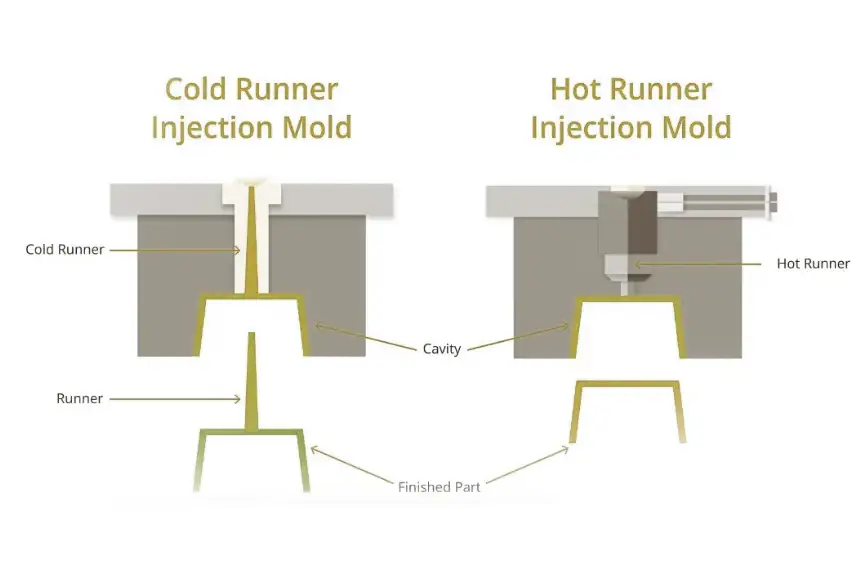
What Is a Runner System in Injection Molding?
A runner system is the channel network that delivers molten plastic from the injection molding machine’s nozzle to the mold cavities.
Its primary functions include:
- Transporting molten plastic efficiently
- Maintaining consistent melt temperature
- Ensuring balanced filling of cavities
- Minimizing pressure loss and defects
Runner systems directly affect:
- Part appearance
- Dimensional accuracy
- Cycle time
- Scrap rate
- Overall manufacturing cost
There are two main types of runner systems:
- Cold Runner Systems
- Hot Runner Systems
What Is a Cold Runner System?
A cold runner system is the traditional and simplest runner design. The runner channels are not heated and cool down with the molded part during each cycle.
How Cold Runner Systems Work
- Molten plastic flows from the nozzle into unheated runner channels
- Plastic fills the mold cavities
- After cooling, both the parts and runners solidify
- Runners are ejected along with the finished parts
- Runners are either discarded or reground
Cold runners are typically made of the same material as the molded part.
What Is a Hot Runner System?
A hot runner system uses electrically heated components to keep the plastic molten inside the runner channels at all times.
How Hot Runner Systems Work
- Plastic flows into a heated manifold
- Heated nozzles maintain melt temperature
- Molten plastic enters the cavities directly
- Only the finished parts solidify and eject
- No runners are formed
Hot runner systems are more complex and use temperature controllers, heaters, thermocouples, and precision components.
Key Differences Hot Runner VS Cold Runner Systems
| Feature | Cold Runner System | Hot Runner System |
|---|---|---|
| Runner temperature | Cooled and solidified | Constantly heated |
| Material waste | High (runners) | Minimal or none |
| Mold cost | Lower | Higher |
| Cycle time | Longer | Shorter |
| Part quality | Good | Excellent |
| Setup complexity | Simple | Complex |
| Maintenance | Low | Moderate to high |
Pros and Cons of Cold Runner Systems
Advantages of Cold Runner Systems
1. Lower Initial Tooling Cost
Cold runner molds are significantly less expensive to design and manufacture. They require no heaters, controllers, or complex wiring.
This makes them ideal for:
- Low-budget projects
- Prototyping
- Short production runs
2. Simple Design and Maintenance
Cold runner systems are mechanically simple, making them easier to:
- Design
- Debug
- Maintain
- Repair
They are more forgiving for new molds and less experienced operators.
3. Wide Material Compatibility
Cold runners work well with:
- Commodity plastics (PP, PE, PS)
- Engineering plastics (ABS, PC, Nylon)
- Heat-sensitive materials
They are especially suitable for materials that degrade if held at high temperatures for long periods.

4. Easy Color and Material Changes
Since runners solidify and are removed each cycle, switching colors or materials is faster and cleaner than in hot runner systems.
Disadvantages of Cold Runner Systems
1. Material Waste
The biggest drawback is runner waste.
- Runners can account for 15%–50% of material usage
- Regrinding can degrade material properties
- Some resins cannot be reground
This increases long-term material costs.
2. Longer Cycle Times
Cold runners must cool and solidify before ejection, extending cycle times compared to hot runner systems.
3. Additional Post-Processing
Cold runners often require:
- Manual or automatic runner separation
- Trimming or degating
- Handling and recycling
This adds labor and operational costs.
4. Less Control Over Melt Flow
Cold runners may experience:
- Inconsistent filling
- Pressure loss
- Higher risk of short shots
Especially in multi-cavity molds.
Pros and Cons of Hot Runner Systems
Advantages of Hot Runner Systems
1. No Runner Waste
Hot runner systems eliminate runners, resulting in:
- Zero material waste
- Lower raw material cost
- Cleaner production
This is especially important when using expensive resins like PEEK, PPSU, or medical-grade plastics.
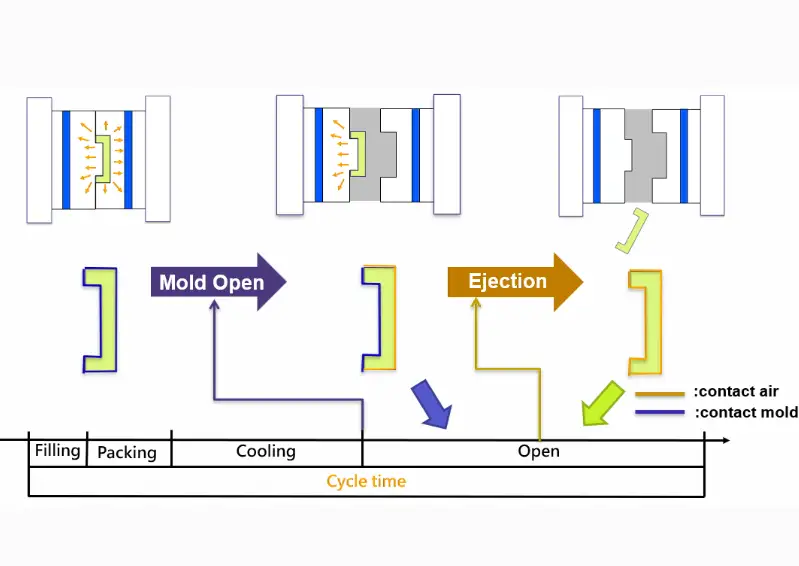
2. Shorter Cycle Times
Since runners do not need to cool:
- Parts cool faster
- Mold opens sooner
- Overall cycle time is reduced
This improves productivity and lowers per-part cost.
3. Superior Part Quality
Hot runners provide:
- More consistent melt temperature
- Balanced cavity filling
- Reduced sink marks and weld lines
- Better surface finish
Ideal for high-precision and cosmetic parts.
4. Improved Design Flexibility
Hot runner systems allow:
- Direct gating into the part
- Multiple gate locations
- Complex multi-cavity layouts
This improves part design freedom and mold efficiency.
Disadvantages of Hot Runner Systems
1. Higher Initial Cost
Hot runner molds are more expensive due to:
- Heated manifolds
- Nozzles and controllers
- Electrical components
Initial tooling cost can be 30%–70% higher than cold runner molds.
2. Complex Maintenance and Setup
Hot runner systems require:
- Skilled technicians
- Temperature control tuning
- Regular inspection
Downtime can be more costly if issues occur.
3. Longer Color Changeover Time
Changing colors or materials can be difficult because molten plastic remains in the system.
Purging can be time-consuming and expensive.
4. Risk of Thermal Degradation
Some materials can degrade if:
- Held at high temperature for too long
- Poor temperature control occurs
This makes hot runners less suitable for certain heat-sensitive plastics.
Cost Comparison: Hot Runner vs Cold Runner systems
Short-Term Costs
- Cold runner systems have lower mold costs
- Hot runner systems require a higher upfront investment
Long-Term Costs
Hot runner systems can significantly reduce:
- Material waste
- Labor costs
- Cycle time
For high-volume production, hot runners often become more cost-effective over time.
Rule of Thumb
- Low volume or short runs → Cold Runner
- High volume or long-term production → Hot Runner
Material Compatibility Considerations
Best Materials for Cold Runner Systems
- PVC
- PET
- TPU
- Heat-sensitive resins
- Frequent color-change materials
Best Materials for Hot Runner Systems
- ABS
- PP
- PE
- PC
- Nylon
- High-performance resins (with proper temperature control)
Material behavior plays a critical role in system selection.
Industry Applications
Automotive Injection Molding
- Hot runners for high-volume, precision components
- Cold runners for prototyping or low-volume parts
Medical Devices
- Hot runners for clean, waste-free production
- Cold runners for sensitive or specialty materials
Packaging Industry
- Hot runners dominate due to speed and material savings
- Thin-wall containers benefit greatly from hot runner technology
Consumer Goods
- Both systems are widely used, depending on product volume and complexity
How to Choose the Right Runner System
Ask the following questions:
- What is the expected production volume?
- How expensive is the plastic material?
- Are frequent color changes required?
- How critical is part appearance?
- What level of dimensional precision is needed?
- What is the available tooling budget?
Decision Summary
| Scenario | Recommended System |
|---|---|
| Low-volume production | Cold Runner |
| High volume production | Hot Runner |
| Tight tolerances | Hot Runner |
| Frequent color changes | Cold Runner |
| Expensive materials | Hot Runner |
| Simple part geometry | Cold Runner |
Future Trends in Runner System Technology
- Energy-efficient hot runner heaters
- Improved temperature control systems
- Modular hot runner designs
- Hybrid runner systems
- Smart mold monitoring
As technology advances, hot runner systems are becoming more reliable, affordable, and easier to maintain.
Conclusion: Hot Runner vs Cold Runner Systems
Both hot runner and cold runner systems have clear advantages and limitations. There is no universal “best” option—the right choice depends on production volume, material type, cost targets, and quality requirements.
- Cold runner systems offer simplicity, lower upfront cost, and flexibility
- Hot runner systems provide efficiency, superior quality, and long-term savings
Working with an experienced injection molding partner can help you evaluate your needs and select the most cost-effective and reliable runner system for your application.