

In modern plastic manufacturing, insert molding and overmolding are two advanced injection molding techniques widely used to create high-performance, multi-material components.
Both processes allow manufacturers to combine plastics with metals or other materials in a single molded part, reducing assembly steps, improving product durability, and enhancing functionality.
However, despite their similarities, insert molding and overmolding are fundamentally different processes with distinct advantages, limitations, and ideal use cases. Choosing the wrong method can increase costs, complicate tooling, or compromise product performance.
In this comprehensive guide, we will explore insert molding vs overmolding, covering their definitions, processes, key differences, material options, design considerations, tooling requirements, applications, costs, and how to choose the right solution for your project.
What Is Insert Molding?
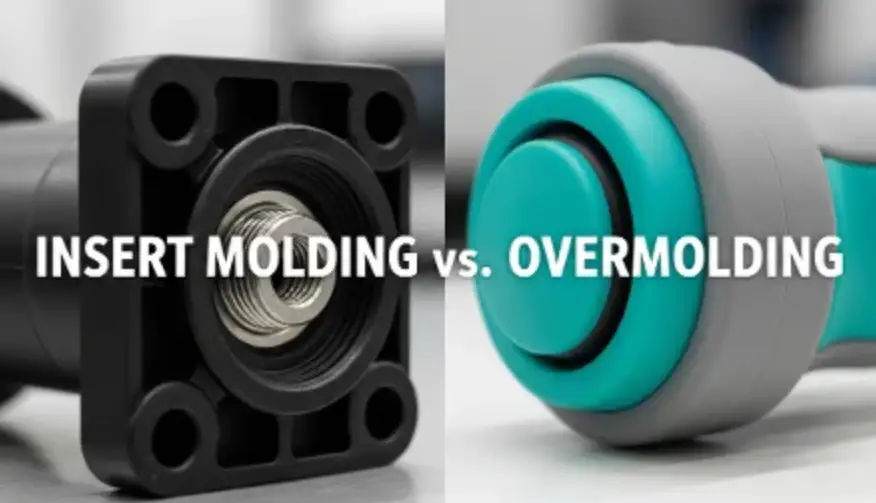
Insert molding is an injection molding process where a pre-formed insert—usually made of metal, ceramic, or another rigid material—is placed into a mold cavity before molten plastic is injected around it. Once the plastic cools and solidifies, the insert becomes permanently encapsulated within the molded plastic part.
The insert is typically positioned manually or automatically using robotics, and the plastic material bonds mechanically—or sometimes chemically—to the insert during the molding process.
Common Insert Materials
- Metal inserts (brass, steel, aluminum)
- Threaded fasteners
- Electrical contacts and terminals
- Bushings, pins, and shafts
- Ceramic or rigid plastic inserts
Typical Insert Molding Materials
- Nylon (PA6, PA66)
- Glass fiber reinforced nylon
- Polycarbonate (PC)
- ABS
- PBT and PET
- High-performance thermoplastics (PPS, PEEK)
Insert molding is widely used to produce structural plastic components that require high strength, durability, and integrated metal features.
What Is Overmolding?
Overmolding is a multi-step injection molding process where one material is molded over another material to create a layered or multi-material component. The first molded part (called the substrate) is placed into a second mold, where a secondary material is injected over it.
Unlike insert molding, overmolding usually involves plastic-to-plastic bonding, although rubber or elastomer materials are commonly used as the overmold layer.
Common Overmolding Materials
- Thermoplastic elastomers (TPE)
- TPU (thermoplastic polyurethane)
- Silicone rubber (LSR)
- Soft-touch elastomers
- Rigid thermoplastics (ABS, PC, PP) as substrates
Overmolding is frequently used to improve grip, comfort, aesthetics, sealing, and vibration damping.

Insert Molding vs Overmolding: Core Process Differences
Although both techniques involve combining multiple materials, the manufacturing process differs significantly.
Insert Molding Process Overview
- Insert is manufactured separately (metal stamping, machining, etc.)
- The insert is placed into the injection mold
- Molten plastic is injected around the insert
- Plastic cools and locks the insert in place
- The finished part is ejected as a single integrated component
This process eliminates secondary assembly steps such as press-fitting, welding, or fastening.
Overmolding Process Overview
- The first material (substrate) is injection molded
- Substrate is transferred to a second mold
- The second material is injected over the substrate
- Materials bond through mechanical or chemical adhesion
- The finished multi-material part is ejected
Overmolding can be done using two-shot injection molding, rotary molds, or manual transfer molding, depending on volume and complexity.
Key Differences Between Insert Molding and Overmolding
| Aspect | Insert Molding | Overmolding |
|---|---|---|
| Primary purpose | Integrate metal or rigid inserts | Combine multiple plastic or elastomer layers |
| Materials | Plastic + metal/ceramic | Plastic + plastic or rubber |
| Bonding method | Mechanical encapsulation | Chemical + mechanical bonding |
| Production steps | Single molding cycle | Multiple molding steps |
| Tooling complexity | Moderate | Higher (multi-shot molds) |
| Assembly reduction | Eliminates fastening | Enhances functionality and ergonomics |
| Cost structure | Lower per part at scale | Higher tooling, efficient at volume |
Understanding these differences is critical when selecting the most suitable molding method.
Material Compatibility Considerations
Insert Molding Material Compatibility
Insert molding focuses on mechanical interlocking, so chemical compatibility is less critical. However, material selection still impacts performance.
Key considerations include:
- Plastic shrinkage around metal inserts
- Thermal expansion differences
- Corrosion resistance
- Insert surface texture for better bonding
Common pairings include brass inserts with nylon, steel inserts with glass-filled polymers, and aluminum inserts with PBT.
Overmolding Material Compatibility
Overmolding requires material-to-material adhesion, making compatibility critical.
Factors affecting adhesion:
- Surface energy of the substrate
- Processing temperature
- Mold temperature
- Use of primers or surface treatments
Common overmolding combinations include:
- TPE over ABS or PC
- TPU over nylon
- Silicone over rigid plastics (with special tooling)

Design Considerations: Insert Molding vs Overmolding
Insert Molding Design Guidelines
- Provide undercuts or knurling on inserts for the mechanical lock
- Avoid sharp corners to reduce stress concentration
- Ensure proper insert positioning to prevent shift
- Account for differential thermal expansion
- Maintain uniform wall thickness around inserts
Insert molding is ideal for load-bearing parts, threaded features, and electrical connections.
Overmolding Design Guidelines
- Design mechanical interlocks for stronger bonding
- Ensure uniform overmold thickness
- Avoid air traps between layers
- Select compatible materials for adhesion
- Optimize gate locations to prevent flow marks
Overmolding excels in ergonomic designs, soft-touch surfaces, and sealed components.
Tooling and Manufacturing Complexity
Insert Molding Tooling
- Standard injection molds with insert pockets
- May require insert-loading automation
- Lower mold cost compared to multi-shot systems
- Faster tooling lead time
Tooling complexity increases with tight tolerances and multiple inserts, but remains relatively manageable.
Overmolding Tooling
- Two-shot or multi-shot molds
- Rotary or indexing mold systems
- Higher tooling cost
- Longer mold development time
Overmolding tooling offers greater design freedom but requires higher upfront investment.
Production Efficiency and Cost Comparison
Insert Molding Cost Profile
- Lower tooling cost
- Reduced labor and assembly costs
- Faster cycle times
- Highly cost-effective for metal-plastic integration
Insert molding is ideal for high-volume industrial components requiring strength and precision.
Overmolding Cost Profile
- Higher tooling investment
- Efficient for large production runs
- Reduces secondary assembly (grips, seals, coatings)
- Adds value through functionality and aesthetics
Overmolding becomes cost-effective when functional integration outweighs tooling expense.
Typical Applications of Insert Molding
Insert molding is commonly used in industries that demand structural integrity and reliability.
Automotive
- Threaded plastic housings
- Electrical connectors
- Sensor components
- Under-the-hood parts
Electronics and Electrical
- Terminal blocks
- Connector pins
- Switch housings
- EMI shielding components
Medical Devices
- Surgical instrument handles
- Implantable device housings
- Catheter components with metal reinforcements
Industrial Equipment
- Load-bearing brackets
- Fastener-integrated plastic parts
- Wear-resistant components
Typical Applications of Overmolding
Overmolding is preferred where comfort, sealing, and aesthetics are important.
Consumer Products
- Tool handles
- Toothbrushes and razors
- Wearable devices
- Smartphone cases
Medical and Healthcare
- Soft-touch medical grips
- Sealed diagnostic devices
- Patient-contact components
Automotive Interiors
- Control knobs
- Steering wheel components
- Interior trim with soft surfaces
Electronics
- Shock-absorbing housings
- Waterproof enclosures
- Vibration-damping parts

Quality Control and Reliability
Insert Molding Quality Control
- Insert positioning verification
- Pull-out and torque testing
- Dimensional inspection
- Electrical continuity testing (if applicable)
Overmolding Quality Control
- Adhesion strength testing
- Peel and shear tests
- Visual inspection for delamination
- Environmental and aging tests
Both processes require tight process control, but overmolding demands extra attention to bond integrity.
Insert Molding vs Overmolding: Which Should You Choose?
Choose insert molding if:
- You need metal or rigid reinforcement
- Structural strength is critical
- You want to eliminate fasteners and assembly
- Cost efficiency at scale is important
Choose overmolding if:
- You need soft-touch, grip, or sealing features
- Aesthetic appeal matters
- Multi-material functionality is required
- Product differentiation is a priority
In some advanced designs, insert molding and overmolding are combined to create highly integrated, high-performance components.
Future Trends in Insert Molding and Overmolding
- Increased use of automation and robotics
- Advanced material combinations for better bonding
- Sustainable and recyclable overmold materials
- Integration with Industry 4.0 process monitoring
- Lightweighting strategies for automotive and electronics
Both processes continue to evolve as material science and mold technology advance.
Conclusion
Insert molding and overmolding are powerful injection molding technologies, each offering unique benefits for modern manufacturing. While insert molding excels at integrating metal components into plastic parts with strength and precision, overmolding enables multi-material designs that improve ergonomics, aesthetics, and functionality.
Understanding the key differences between insert molding and overmolding, including materials, tooling, costs, and applications, allows manufacturers to select the most effective solution for their specific product requirements.
By choosing the right process and working with an experienced injection molding partner, companies can achieve higher performance, lower assembly costs, and superior product quality in today’s competitive manufacturing landscape.