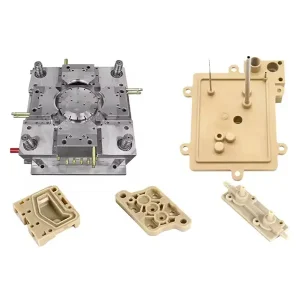
Custom high precision injection molding with AIM plastic, with design and engineering support, OEM, ODM, injection mold making, competitive price
High precision injection molding is at the core of modern plastic manufacturing and advanced molding processes. From medical devices and automotive components to electronics, optical systems, and aerospace parts, industries today demand plastic parts and plastic components with extremely tight tolerances, consistent dimensions, and flawless surface quality.
As plastic products become smaller, lighter, and more complex, traditional plastic injection molding processes are no longer enough to meet today’s performance requirements. This is where high-precision injection molding stands out — delivering micron-level accuracy, high repeatability molding, and dependable performance at scale. Injection molding offers a proven way to manufacture high-quality molded plastics with a high level of precision.
[bg_collapse_level2 view=”link” color=”#e34507″ icon=”arrow” expand_text=”Read More” collapse_text=”Read Less” ]
In this guide, we’ll explore what high precision injection molding is, how the injection molding process works, its key advantages, materials, molds, and tooling requirements, industries served, and how to choose the right plastic injection molding company for precision-critical projects.
High precision injection molding is an advanced plastic injection molding process designed to produce injection molded plastic parts with very tight dimensional tolerances, typically within ±0.01 mm to ±0.02 mm, and sometimes even tighter depending on the application, mold design, and material property.
Unlike standard injection molding, which focuses mainly on volume and cost efficiency, precision injection molding prioritizes:
Dimensional accuracy
High-accuracy plastic parts
Part-to-part consistency
Surface finish quality
Mechanical reliability
Long-term dimensional stability and controlled shrinkage
This high-precision plastic injection approach combines precision mold tooling, high-precision mold design, advanced injection molding technology, and strict process control. Every injection molding machine, tool, and parameter is optimized to achieve accurate plastic components with repeatable results.
In many industries, even the smallest dimensional error in an injection-molded component can lead to product failure, poor assembly, or performance loss.
Examples include:
Medical connectors that must seal perfectly
Electronic and optical housings requiring precise alignment
Automotive plastic components are exposed to vibration, heat, and load
Micro injection molding parts where microns affect functional performance
High-precision injection molding ensures that every plastic component meets design intent — not just the first samples, but across full-scale production runs. This level of control is essential for parts and products requiring close tolerance molding and consistent material behavior.
Tight tolerance injection molding allows manufacturers to control injection molding tolerances with exceptional precision. Depending on part size, geometry, and mold structure, precision plastic molding can achieve:
±0.01 mm for small, critical micro components
±0.02–0.05 mm for larger structural plastic parts
Such precise control ensures accurate plastic assembly, reliable fits, and stable performance across different molding processes.
High precision injection molding focuses on repeatability. Once the injection molding process is scientifically optimized, millions of precision injection-molded parts can be produced with minimal variation.
This high repeatability molding capability:
Reduces assembly issues
Minimizes scrap and rework
Improves product quality and lifecycle reliability
Statistical process control and scientific injection molding techniques help maintain a stable manufacturing window.
High-precision molds are manufactured using CNC machining, EDM, and polishing processes to extremely tight standards. Precision mold surfaces may be mirror-finished or textured according to exact design requirements.
This results in:
Smooth, defect-free molded plastics
Minimal flash, sink marks, or flow lines
Reduced need for secondary finishing
For cosmetic, optical, or functional plastic products, this is a major competitive advantage.
High-precision injection molding enables manufacturers to produce plastic components with complex geometries, including:
Thin-wall sections
Micro features
Fine ribs and details
Integrated functional elements
With advanced precision mold flow analysis, controlled plasticizing, and optimized melt behavior, complex injection molding to produce high-quality parts becomes achievable in a single cycle.
Although precision mold tooling and high-precision mold design require higher upfront investment, high-precision injection molding becomes cost-effective for:
Medium to high-volume production
Custom precision plastic components
Applications that eliminate secondary operations
Over time, reduced rejection rates, lower maintenance, and consistent output provide a strong long-term advantage.
The injection molding process follows the same core principles as conventional plastic injection molding, but every stage is tightly controlled to achieve a high level of precision.
Everything starts with the mold.
High-precision mold design focuses on dimensional accuracy, flow balance, and thermal stability. Key elements include:
CAD/CAM modeling with tolerance analysis
Precision mold flow analysis
Optimized gating and runner systems
Uniform cooling channel layout to control temperature
Even small design deviations in molds and tooling can cause dimensional variation, warpage, or shrinkage, making precise mold design essential.
Precision molds are manufactured using premium materials such as:
Hardened tool steel (H13, SKD61)
Stainless steel (S136) for corrosion-resistant applications
Advanced CNC machining, EDM, grinding, and polishing processes are used to achieve micron-level accuracy. Mold cores, cavities, and inserts are measured using CMM systems to ensure every tool meets design specifications.
Material preparation plays a critical role in high-precision plastic injection molding.
Key considerations include:
Controlled resin drying to precise moisture levels
Stable material property and batch consistency
Optimized melt flow behavior during plasticizing
Any variation in moisture, melt viscosity, or temperature can directly affect dimensional accuracy and surface quality.
High-precision injection molding machines are equipped with:
High-resolution servo drives
Accurate injection speed and pressure control
Stable clamping systems
Closed-loop monitoring of melt and temperature
These injection molding machines ensure consistent cycle-to-cycle performance and accurate plastic filling behavior.
Precision molding processes rely on strict monitoring and optimization of:
Injection pressure and speed
Melt temperature and mold temperature
Holding pressure and time
Cooling balance to minimize shrinkage
Scientific injection molding techniques and SPC systems are used to optimize and maintain stable production conditions.
Final inspection ensures that precision injection-molded parts meet all dimensional and functional requirements.
Inspection methods include:
CMM dimensional measurement
Optical inspection systems
Surface roughness and finish testing
Functional and property validation
Only plastic parts that pass all quality criteria are approved for full-scale production, ensuring consistent high-quality parts and products.
Material choice is crucial for dimensional stability, geometric accuracy, and long-term performance in high-precision injection molding applications. Selecting the right range of polymers directly impacts the accuracy of parts, tolerance control, and reliability across production runs.
A comprehensive understanding of material behavior allows manufacturers to optimize molding processes for flawless surface quality, tight tolerances, and cost-effectiveness, especially when producing precise parts for demanding industries.
ABS – Offers good dimensional accuracy, stable molding behavior, and economical processing for high-volume plastic parts
Polycarbonate (PC) – High strength, transparency, and impact resistance, widely used for optics, lenses, and electronics precision plastic housings
Nylon (PA6 / PA66) – Excellent mechanical strength, heat resistance, and durability for automotive precision injection molding applications
POM (Acetal) – Known for exceptional precision, low friction, and tight tolerance capability in moving components
PET / PBT – Provide chemical resistance, dimensional stability, and consistent performance in injection molded electrical and industrial parts
These high-performance plastic materials are commonly used in aerospace, medical, electronics, and industrial equipment applications where specification compliance and precision part consistency are critical.
PEEK – Outstanding high-temperature resistance, chemical stability, and lightweight strength for aerospace and medical engineering applications
PPS – Maintains dimensional accuracy under heat and load, ideal for tight tolerance components
LCP – Extremely low shrinkage, exceptional flow, and ideal for micro-tolerance plastic components and optical and micro-feature molding
Ultem (PEI) – High strength, flame resistance, and reliability for electronics and aerospace housings
These materials support precision molding for medical devices, optics, and high-end electronic systems where flawless performance is essential.
Glass-fiber reinforced plastics
Carbon-fiber reinforced plastics
These materials significantly improve stiffness, strength, and reliability, but require advanced CNC-machined precision molds, precision gating and runner design, and robust warpage and shrinkage control to maintain dimensional accuracy and reduce scrap rates. Expert mold temperature control systems and modeling are essential to achieve consistent results.
Medical devices demand extreme precision, cleanliness, and reliability.
Typical applications include:
Syringe components
Diagnostic device housings
Surgical instrument parts
Drug delivery systems
Precision molding ensures compliance with strict medical industry standards through cleanroom injection molding, precision plastic part inspection, and statistical process control molding. This capability is essential for producing accurate plastic parts with consistent quality.
Electronics require exact fits, insulation properties, and stable dimensional accuracy.
Applications include:
Connectors
Switch housings
Sensor components
Micro electronic enclosures
High-precision tooling systems and low-variance production molding ensure electronics precision plastic housings meet tight tolerances and maintain flawless assembly accuracy throughout repeatable high-volume precision molding.
Modern vehicles contain hundreds of precise injection molded plastic components.
Common uses include:
Sensor housings
Fuel system components
Interior mechanisms
EV battery connectors
Automotive precision injection molding improves safety, reliability, and cost-effectiveness while supporting lightweight design goals and long-term durability.
Aerospace components must withstand extreme temperatures, vibration, and stress.
Precision molding supports:
Lightweight structural components
Insulation parts
High-performance connectors
Tight tolerances, high-precision mold maintenance, and exceptional dimensional accuracy control are essential for aerospace applications where downtime and failure are unacceptable.
Precision plastic components are widely used in:
Automation systems
Robotics
Pneumatic and hydraulic systems
High-precision injection molding ensures smooth operation, minimal wear, and long service life through reliable molding capabilities and in-house engineering expertise.
Despite its advantages, precision molding presents technical and operational challenges.
Precision molds are:
More expensive
Time-intensive to manufacture
Sensitive to wear
However, CNC machined precision molds deliver long-term value by reducing scrap, improving precision part consistency, and supporting stable production runs.
Even minor changes in:
Temperature
Pressure
Material batch
Can affect dimensional accuracy and geometric stability. This requires experienced engineering teams, automated precision molding systems, and comprehensive quality control in injection molding.
Precision molding must account for:
Material shrinkage behavior
Fiber orientation
Cooling balance
Advanced modeling, simulation, and warpage and shrinkage control strategies are essential to maintain specification compliance.
Mold flow analysis is a critical engineering tool in precision molding process optimization.
It helps predict:
Flow patterns
Pressure distribution
Weld lines
Air traps
Shrinkage and warpage
Using mold flow modeling early improves dimensional accuracy control, reduces scrap, and enhances overall cost-effectiveness while ensuring the highest quality results.
Typical tolerance ranges demonstrate the capability of high precision injection molding across different applications:
Part Type | Tolerance
Micro parts | ±0.005–0.01 mm
Small precision parts | ±0.01–0.02 mm
Medium components | ±0.02–0.05 mm
Large precision parts | ±0.05–0.1 mm
Actual tolerance levels depend on material selection, mold design, part geometry, and the accuracy of parts required by the application.
Not all molders have the expertise, facility, and engineering capability to deliver true precision.
Proven expertise in precision projects
Advanced CNC and EDM tooling
High-precision injection machines
In-house mold design, modeling, and maintenance
Comprehensive quality control systems
What tolerances can you guarantee?
Do you use mold flow analysis and SPC?
How do you control process variation?
What precision plastic part inspection equipment do you use?
Can you support long-term production stability with minimal downtime?
The precision molding industry continues to evolve.
AI-driven process optimization
Real-time dimensional accuracy monitoring
Fully automated precision molding production lines
These technologies help automate operations, improve reliability, and maintain low-variance production molding.
Demand is increasing for:
Medical micro components
Electronics miniaturization
Wearable devices
Micro-tolerance plastic components and optical and micro-feature molding will continue to push precision limits.
Recyclable engineering plastics
Energy-efficient machines
Reduced material scrap
Sustainability, reliability, and economical production are becoming equally important alongside precision.
High precision injection molding is no longer a niche capability — it is a core requirement for modern manufacturing.
By combining:
High-precision tooling systems
Advanced injection molding machines
Expert engineering and process optimization
Rigorous quality control and inspection
Manufacturers can produce plastic parts and products that meet the highest standards of accuracy, reliability, and performance.
For industries where every micron matters, high precision injection molding delivers exceptional value, precision, and confidence — making it the backbone of today’s most demanding industrial applications.
[/bg_collapse_level2]